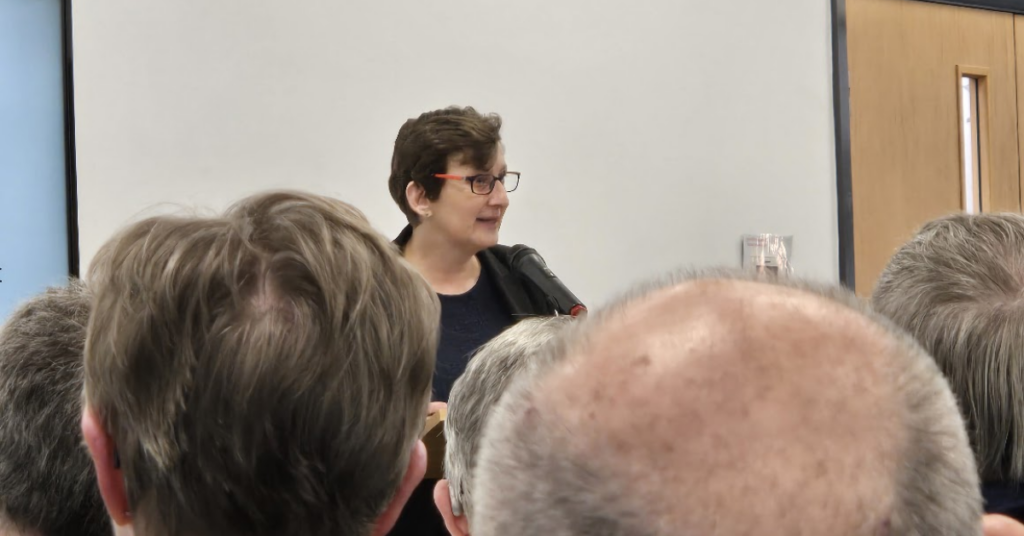
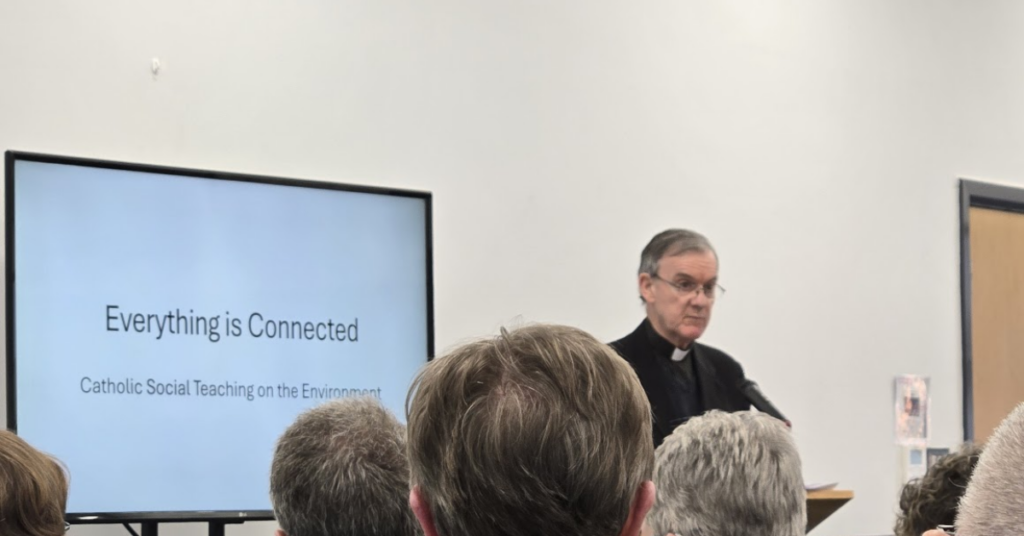
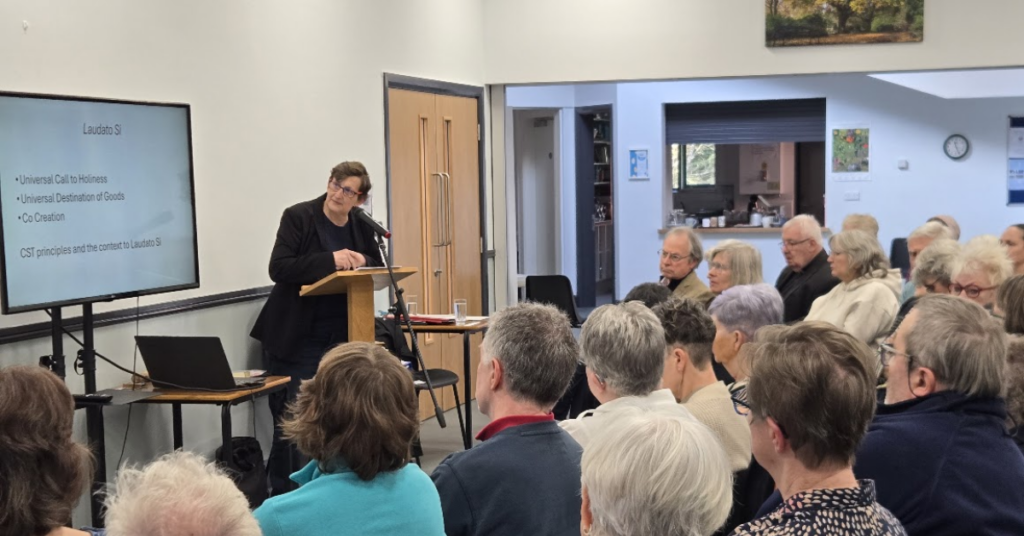
On 21 March 2026 eighty people from seventeen parishes across the diocese of Hallam gathered at St Vincent’s church in Sheffield for a day of reflection. They were joined by nine other groups including representatives from the Anglican and Methodist Churches and Crookes Joint Eco Churches. The day was organised by St Vincent’s ‘Live Simply’ group and it formed part of the Lent programme for the Hallam Formation and Mission team. The speakers were Dr Maria Exall and John Arnold, bishop of Salford. Maria is an Honorary Fellow of the Centre for Catholic Social Thought and Practice at Durham University and an alumna of the University of Sheffield; Bishop John is the spokesperson for the Catholic Bishops’ Conference on the environment and President of Pax Christi.
Until the publication of Laudato Si (Pope Francis, 2015) many Catholics were unaware of the established theology around caring for our common home. Bishop John outlined the developments in thinking around Care for Creation and what is called Catholic Social Teaching (CST), stressing that these concepts were not new. In the Book of Genesis, God commands humans to “till and keep” the earth, which implies stewardship rather than exploitation. Early Christian writers placed a huge emphasis on justice, charity and human dignity. In more recent times it was Pope Leo XIII’s 1891 encyclical Rerum Novarum which further developed CST, addressing the rights and duties of both workers and employers, and affirming the Church’s concern for social justice amid rapid industrialisation. Popes Paul VI, John Paul II, Benedict XVI and Francis all issued encyclicals making it clear that the concepts of “solidarity” and ‘care for creation’ are core Christian virtues; these ideas should be central to our lives as Catholics.
Maria dug deeper into the importance of Catholic Social Teaching simplifying some of the terminology (‘technocratic paradigm anyone?) and exploring its practical implications. It was demanding stuff, leaving little room for us to ‘be bystanders’ to local, national and even world events; CST reinforces our Christian responsibility through principles such as the common good, solidarity, and care for the poor. Maria said simply: all these things are connected, outlining how environmental damage such as pollution, climate change and deforestation usually affects the most vulnerable people first, especially those who rely directly on natural resources for survival, leading to food shortages, displacement, and health problems. As Catholics we need to understand these issues so that we can act from knowledge.
In group discussion later, ideas were shared, frustrations aired, and practical solutions offered with an overwhelming emphasis on not giving in to a sense of hopelessness. One image that has remained with me from the day is that we are all like individual drops of rain; without each drop there would be no rivers, dams, seas or oceans. Our small actions matter.
Practicing Catholic Social Teaching in relation to the environment involves making practical choices: reducing waste, using resources responsibly, and advocating for policies that protect the planet, actions demonstrating love not only for God but for neighbour and future generations. The day of reflection reinforced our belief that the natural world is not just a resource to be used but a sacred place revealing God’s glory and reflecting God’s presence. Caring for creation, truly hearing the ‘cry of the poor and the cry of the earth’, is an expression of faith in action, uniting belief with responsibility.
May the earth remain a safe and beautiful home for everyone and for those who follow in our footsteps. Ann Burke – St. Vincent’s Live Simply Group